
The Drawbacks of the Government-Subsidized Mortgage (ZAKAOT)
Sometimes a gift is worth turning down, even when it's free. That can be the case with the government-subsidized mortgage (ZAKAOT), available to first-time home buyers. The government (through the Ministry of Construction and Housing) tries to help first-time buyers by offering them a discounted loan, but the heavy regulations it piles onto that loan can leave borrowers worse off — so the loan can actually work against them.
Reminder: What is the government-subsidized mortgage (ZAKAOT)?
As you may recall, the government-subsidized mortgage (ZAKAOT) is a state-backed loan granted through the mortgage banks to those buying their first home (with a few exceptions). We've devoted a whole page to the government-subsidized mortgage and all its technical details, so here we'll cover only the relevant points briefly. It's a loan linked to the Consumer Price Index (CPI) — that is, to inflation — at a fixed interest rate (meaning the rate doesn't change over the life of the loan). The rate on the loan is set at the average mortgage interest rates (as published by the Bank of Israel) minus half a percent, but no more than three percent per year.
The amount of government-subsidized mortgage you qualify for depends on your civil status and on the location of the property being purchased or built. The more children, siblings, and years of marriage you have, the larger the loan you'll qualify for.
Before we get into the problems with this loan, let's quickly recap its advantages:
- There is no early prepayment fee on this loan under section 2 of the Banking Ordinance (Early Repayment of Housing Loans) - 2002.
- A larger discount on the early prepayment fee of the other loans in our mortgage mixture, compared with a mixture without the government-subsidized mortgage (under section 8 of the Banking Ordinance (Early Repayment of Housing Loans) - 2002).
- A discount on the property appraisal. Having the government-subsidized mortgage in our mixture entitles us to a discount on the appraisal fee.
You get all the benefits listed above no matter how much you actually borrow in the government-subsidized mortgage! So your eligible amount might be 100,000 NIS, but taking just 10,000 NIS is enough to enjoy all of them.
So much for the advantages — now let's see what's wrong with it. The government-subsidized mortgage has one obvious drawback and three hidden ones, and it's the hidden ones that can really undermine the case for using it. The obvious, well-known drawback is that it's CPI-linked. That CPI exposure raises the monthly payment through compound interest every time inflation rises.
Example: suppose you borrowed 100,000 NIS over a 20-year term at a 2% interest rate. The monthly payment, on an annuity amortization schedule (Spitzer), comes to 505 NIS per month (using the PMT function in Excel). If inflation rose 1% this month (an illustrative, slightly extreme example), then the principal grows by 1% and the monthly payment grows by 1% along with it. That is, 505 NIS becomes 510 NIS. So you need to be aware of the risk you're taking on when you take this loan.
But we already knew that. Now let's talk about the hidden drawbacks. First, what's a hidden drawback? It's a regulatory rule or constraint that looks small and marginal at first glance, but in practice does real damage to the mortgage mixture you build. The hidden drawbacks are:
- You can't take a grace period on this loan. You have to start repaying principal to the state from the very first payment.
- At the vast majority of banks, it can only be taken in five-year increments — that is, for a term of ten, fifteen, twenty, twenty-five, or thirty years.
- In the overwhelming majority of cases, you can't split it. Say you're entitled to 100,000 NIS in the government-subsidized mortgage — you won't be able to take 30,000 NIS over 20 years and the remaining 70,000 NIS over 25. You have to put all your eggs in one basket.
- Getting the eligibility certificate takes about two to three weeks, depending on how backed up the Ministry of Construction and Housing is. It's highly advisable to obtain the certificate only after you've agreed loan terms with a bank (in short: moving an eligibility certificate between banks is possible but cumbersome and a source of many headaches). In many cases there isn't enough time left to get the certificate, so borrowers give up on it.
How to incorporate the government-subsidized mortgage into the optimal mortgage mixture
As a reminder, our goal is to build the optimal mortgage mixture — that is, among all the mixtures that meet your needs and the regulatory requirements of the Bank of Israel and the banks, to find the best one. When we say best, we usually mean the lowest repayment ratio.
So when does a mixture's optimality take a hit? When, for example, the use of a particular loan is forced on it — and that's exactly what happens with the government-subsidized mortgage. We'll see why in a moment.
Let's look at the situation with a concrete example.
A large government-subsidized mortgage can be a bad gift from the state
Say you need a mortgage of one million NIS. You carried out a proper needs assessment, figured out your cash-flow capacity, and concluded that the right monthly payment for you is 4,400 NIS.
On top of that, you both come from large families and married very young, so you qualify for 200,000 NIS in the government-subsidized mortgage from the Ministry of Construction and Housing. Suppose you chose the following mortgage mixture (Note: this is not a recommended mixture and was chosen purely for illustration):
- 400,000 NIS in a prime-linked loan track for a term of 27 years at an interest rate of 1.25%
- 400,000 NIS in a fixed unlinked (KALATZ) loan for a term of 22 years at an interest rate of 3.7%
- 200,000 NIS in the government-subsidized mortgage for a term of 25 years at an interest rate of 1.85%.
Two quick notes:
(1) The interest rates for the mortgage mixture were taken from the rates common at the time this article was written. They aren't necessarily the rates you'll get when you read this. See here what interest rates are currently available on the various mortgage tracks
(2) The estimated costs of the prime-linked loan track and the government-subsidized mortgage depend on how inflation and the Bank of Israel interest rate move over the life of the loans. We use standard models to estimate what the costs could be. You can see here what macroeconomic models we assume when you are reading this article now.
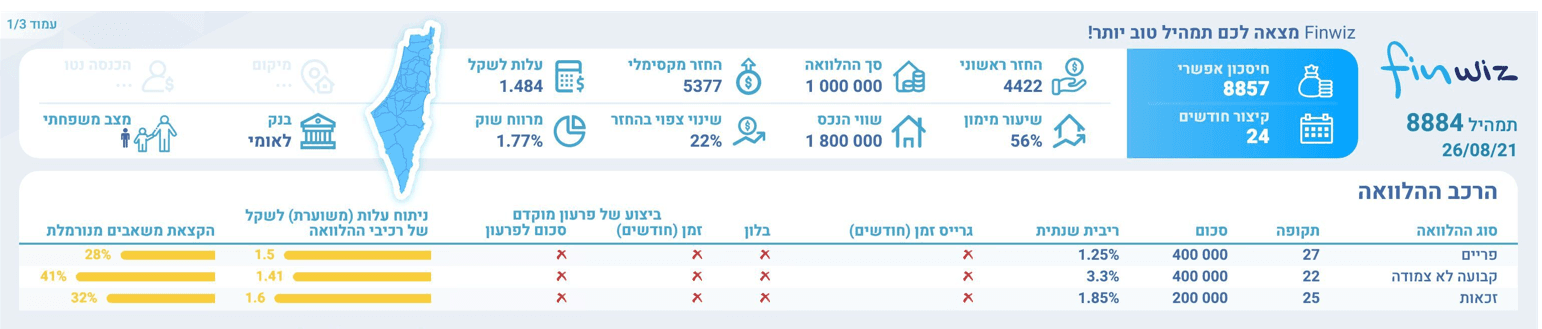
First, the estimated repayment ratio of the mixture is 1.484 (you can see this number to the right of the map of Israel). That is, given the estimated exposure to the prime rate and inflation, for every NIS we borrow we'll pay 48.4 agorot.
Looking closely at each cost in the mixture, it turns out that despite the low interest rate, the government-subsidized mortgage is the most expensive loan in the mixture — its repayment ratio is 1.6 per NIS (you can see this in the yellow horizontal bar charts on the lower left). The loan is expensive because of the CPI exposure and because of its length. The longer a loan is, the more of each monthly payment goes to interest and the less goes to principal.
So to bring the cost of this loan down, we can:
- Shorten the loan to reduce its cost — though this pushes the monthly payment up.
- Reduce the amount of money allocated to it.
If we go with shortening the loan, then because of hidden drawback (b), we can only shorten it to twenty years. On the plus side, shortening the term dropped the rate on the government-subsidized mortgage to 1.58%.
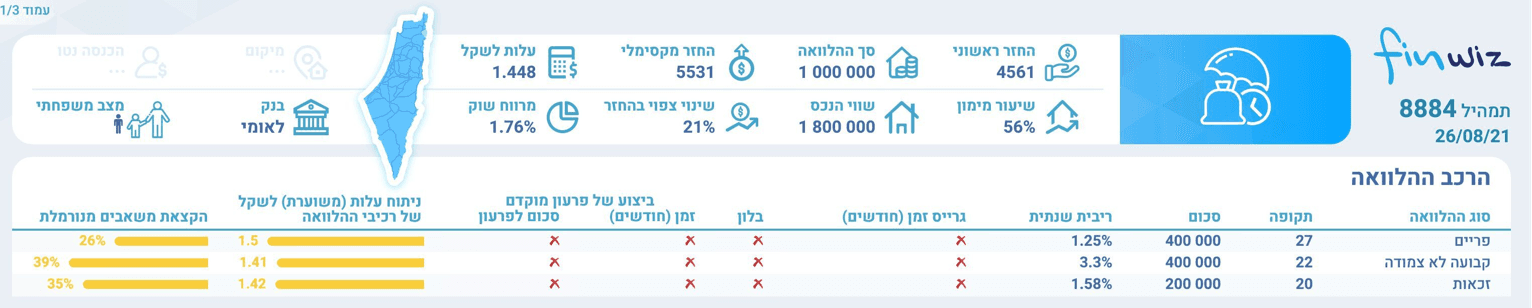
Now, analyzing the new mixture shows that the government-subsidized mortgage has become (almost) the cheapest loan in the mixture, with a repayment ratio of 1.42. The overall cost of the mixture also dropped, to 1.448. We improved things, right?
No. True, the repayment ratio dropped, but the monthly payment rose by 140 NIS to 4,561 NIS compared with our original mixture. That's not what we wanted. And it's not even fair to compare the costs of the two mixtures, because they don't have the same monthly payment.
We want to fit the mortgage to us, not ourselves to the mortgage, so we don't want to raise the monthly payment by 140 NIS. But we can't extend the government-subsidized mortgage again either — that would just put us back where we started. So we extend other loans to bring the payment back down. We choose, for example, to extend the fixed unlinked loan by three years (!) (which makes its interest rate more expensive) and the prime-linked loan by half a year, and that brings us back to the monthly payment we wanted.
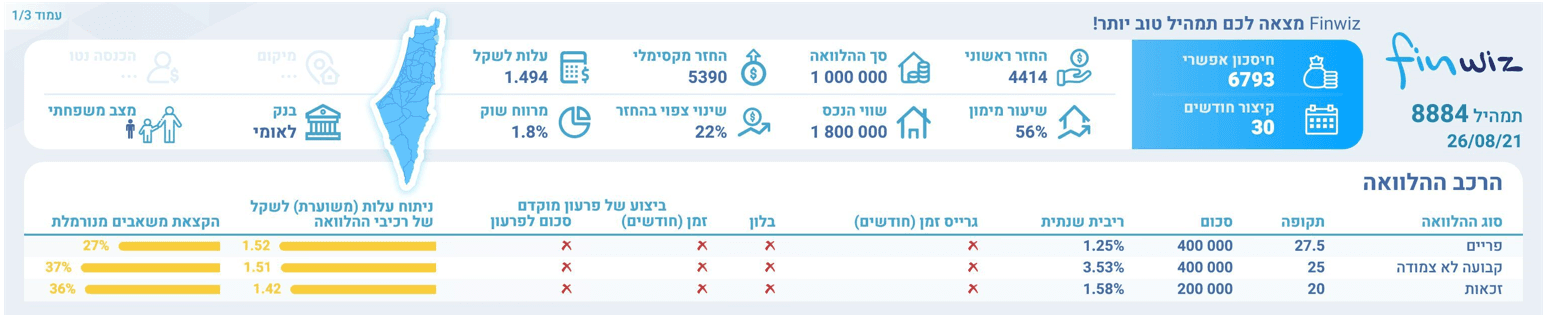
Now the other loans are the most expensive in the mixture. The overall repayment ratio went up, the mixture runs longer, and the estimated maximum monthly payment is higher.
So what actually happened here? We just stretched out the mortgage and damaged it for no good reason, all to "find a place" for 200,000 NIS in the government-subsidized mortgage. Had we taken only 50,000 NIS of it, we wouldn't have had to make such drastic changes.
Summary
If the government-subsidized mortgage makes up a small portion of the mortgage you need, the harm to the mixture is minimal. But once it's a substantial share, the loan really starts to damage the mixture — and in that case, it's worth reducing the amount you take in it.
Yet most borrowers use the full amount they're entitled to from the state. They don't stop to ask whether using all the money is the right call. After all, if someone's handing you a free benefit, wouldn't you take it?
To be clear, we're not arguing against including the loan at all — we're arguing that it's not always worth taking the full loan.
We need to understand its drawbacks and work out how to fold it into the mortgage mixture in a way that still captures its clear advantage — an extra reduction in the early prepayment fee. And if you can get all those benefits with a reduced eligibility amount, isn't that worth doing?
Good luck!