What is a government bond anchor
The most common objective variable in mortgages is the yield to maturity (YTM) of Israeli Government bonds.
Remember the variable-rate loans? The CPI-linked variable-rate loan (MATZ) and the non-CPI-linked variable-rate loan (MALATZ). Once we've established that the rate on these loans will change after a set period (say, in five years, for a variable-rate loan that resets every five years), it's only natural to wonder how much it will actually change. These loans are linked to government bond anchors, and their rates rise and fall as the anchor-rate rises and falls.
Look at the following example, taken from the principle approval of Israel Discount Bank.
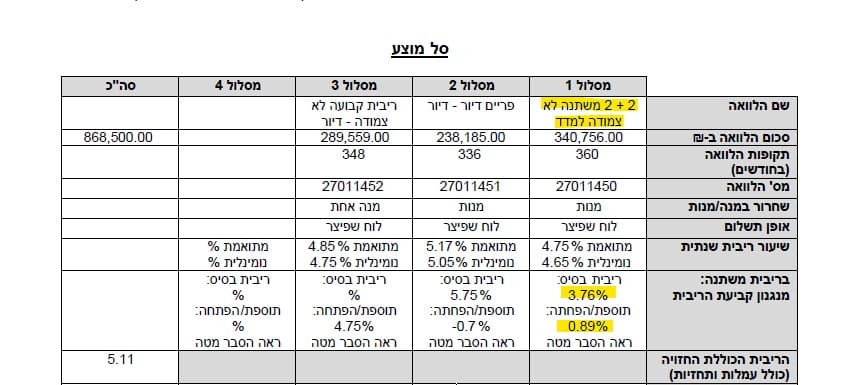
The first loan in the mortgage mixture is a non-CPI-linked variable-rate loan resetting every two years. You can see that the interest rate is 4.65%, based on an anchor-rate of 3.76% plus a spread of 0.89%.
Government bond anchors are published twice a month on the Bank of Israel website. So if we look at the published nominal bond yields, we can see that they match Israel Discount Bank's anchor:
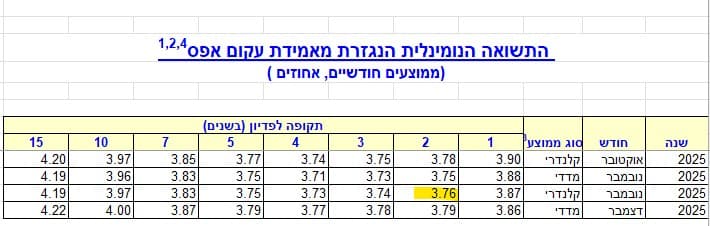
For example, Bank Leumi markets a non-CPI-linked variable-rate loan that resets every two and a half years. Since the Bank of Israel doesn't publish an anchor for two and a half years (as you can see from the table above), Bank Leumi takes an arithmetic average of the two-year anchor and the three-year anchor.
Calculating changes in bond anchors and the prime interest rate
The interest rate on variable-rate loans that reset every X years is updated every X years. So if we took out a loan on 1.1.2026, then on 1.1.2031, our interest rate will be updated in line with the change in the government bond anchor.
Without your having done a thing, the monthly payment can go up. Given the potential risk in these loans, it's worth answering this critical question: if we took out a loan that resets every X years (X could be, say, 5 years), what might the government bond anchor be in X / 2X / 3X / 4X (and so on) years from today?
To keep the explanation simple, let's set X to 5 years.
On a variable-rate track that resets every five years, the interest rate is updated after 5 years, 10 years, 15 years, 20 years, and so on. So the central question is what the government bond anchor (the yield to maturity (YTM) of Israeli Government bonds for a defined period) will be at each of those points from today.
So how do we estimate the "Israeli Government bond yield to maturity for five years, five years from today"? The answer is calculated by a method called forward rate.
The forward rate finds the answer like this. From the yield curve, we can read off the yield to maturity (YTM) at five years and at ten years. If we had 100 NIS and invested it in a ten-year bond, we'd earn a certain amount on our investment.
The profit from that trade has to equal the profit from the following one: investing the same 100 NIS in a five-year bond, and then in five years investing it again for another five years.
The five-year yield, five years out, that makes the profit on both trades identical is the forward rate for five years in five years — in other words, what we can expect to happen to the government bond anchor at the interest-rate reset point five years from now!
Forward Rate Calculation
On our interest-rates page, you can see the expectations for the variable-rate tracks and the prime-linked track — calculated with the forward rate method from the yield curve.
Good luck!