The Bank of Israel Interest Rate and the Prime Rate
On this page we'll give you a concise explanation of what the Bank of Israel interest rate (BOI rate for short) is and why it matters for your mortgage. This is required reading, because this rate affects the cost of your entire mortgage.
- There are a lot of economic concepts here, and we've made every effort to explain them clearly. Our advice: look up additional references for any concept you don't fully understand.
- The mortgage mixture you choose will be affected by what happens to these variables over the years. For example, if you think the Bank of Israel interest rate is likely to stay low, you may prefer mortgage mixtures with greater exposure to the prime rate. Putting a particular loan into your mortgage mixture without understanding the variable it's linked to is a very risky move.
The Bank of Israel rate / Prime rate
We discussed inflation and explained briefly why it must not get too high. We also explained why negative or zero inflation is no good either. In other words, inflation is something worth keeping under control. The main tool the Bank of Israel uses to control and regulate inflation is the Bank of Israel interest rate (BOI rate).
How exactly does this work? After all, you can't influence inflation directly. You can't simply decide, "This year inflation will be exactly 2%" — because inflation reflects the rise and fall in the prices of goods and services across the economy, and those prices are set in the free market. For example, if tomato growers decide to raise the price of greenhouse tomatoes, there's only so much the government can do to stop them.
So what can the government do? It can influence prices in the economy indirectly, by changing financing costs. And it changes financing costs by changing the prime rate.
The BOI rate directly determines the prime rate:
Prime rate = Bank of Israel interest rate + 1.5%
Example: If the BOI rate stands at 0.25%, the prime rate is set at 1.75%.
When the Bank of Israel raises the BOI rate, it makes borrowing more expensive throughout the entire economy. This cools the market, reduces demand, and so drives prices down. Let's walk through an example to see why.
Example: buying a car with a loan
Say you're planning to buy a new car but don't have all the cash to pay for it. One option is to buy the car with a loan.
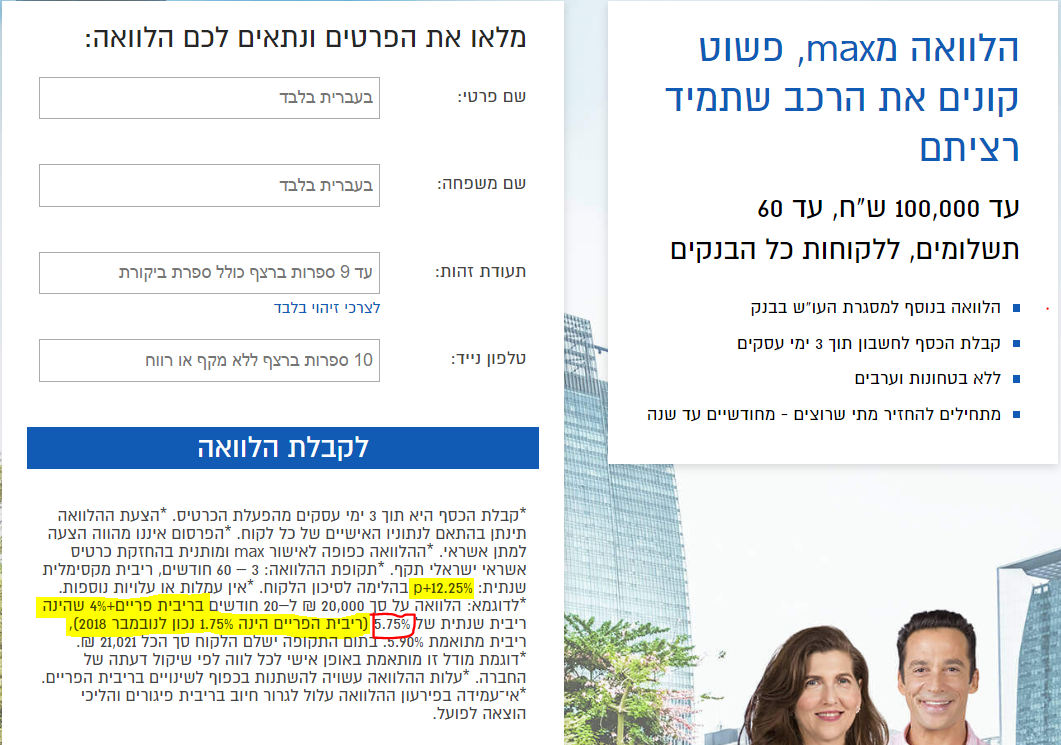
Say the interest rate on the loan is 5.75%. That rate is tied directly to the prime rate — it's a spread of 4% above prime (when the prime rate stands at 1.75%). So if the Bank of Israel raises the BOI rate by, say, 1.5%, the rate on the loan in our example rises by 1.5% too, to 7.25% (!).
For some people, the monthly payment on these loans will be too high, and they'll decide not to buy the car. Now imagine plenty of people making that same decision because of financing costs. Demand falls. Unsold cars pile up on the dealership's lot — in other words, supply rises. If the dealership gets stuck with those cars, whose value drops as time passes, it loses money. So the next step is to lower prices.
Now run the same example in reverse: if the bank lowers rates, it reduces financing costs. That indirectly boosts demand (because more people can afford the loan payments and buy cars), and as a result the prices of goods are likely to rise — meaning inflation goes up.
Frequently asked questions about the Bank of Israel interest rate (BOI rate)
Who sets the Bank of Israel interest rate?
The BOI rate is set by the Monetary Committee of the Bank of Israel. The committee is made up of researchers and economists from the Bank of Israel, and it's headed by the Governor of the Bank of Israel.
On what dates is the Bank of Israel interest rate set?
The Monetary Committee meets eight times a year. The meeting dates are published in advance on the Bank of Israel website. Although the committee meets roughly every six weeks, there have been times in the past when it met specially to respond to major market shifts.
How does the Bank of Israel interest rate affect housing prices?
If the Bank of Israel raises the BOI rate, mortgage costs go up. As a result, fewer people can afford the payments, so they put off buying a home or buy cheaper ones (meaning demand for homes falls). And a drop in demand leads to a drop in housing prices.
How does the Bank of Israel interest rate affect my mortgage payment?
Good luck!